Ultimate Guide to Transportation for your Trip
An Overview of Planes, Trains, Buses, Taxis and Rental Cars
There are many modes of travel and different mobility requirements for each. Deciding how you will get around can feel overwhelming. In this post I will cover mobility considerations for transportation for your trip. For even more detail, see linked posts below!
Airplanes
If you are heading across an ocean for your travel adventure and are not taking a very long boat ride, your plans will include a long-haul flight. As numerous as the news stories may be, flying remains the quickest and safest mode of travel. Let’s look at mobility consideration for air travel.
Mobility at the Airport
Your time at the airport may involve a lot of time on your feet. If you are checking bags, you will need to wait in line at the airline desk. You will need to stand and start/stop walking through potentially long security lines. Larger airports may include long hallways and getting on/off trams. You could easily walk a mile by the time you get to the plane. Even if you do not plan on using a wheelchair for the remainder of your trip, you may want to consider a wheelchair transfer, especially if you will have luggage with you. Once you are at your arrival destination, consider how you will maneuver your luggage. Also consider how you will collect any additional luggage at baggage claim.
This post on the U.S Department of Transportation’s website explains what is included if you opt for a wheelchair transfer at an American airport. It also describes your rights and is where you can file a consumer complaint.

Getting on and off the Airplane
Will you get to the plane via jet bridge or stairs? A jet bridge makes boarding and deplaning much easier. If you have to go out to the tarmac, you will either be taking a winding ramp or stairs with railing on both sides. You need to consider if you able to get your carry-on luggage up and down the stairs or ramp. If a bus is shuttling you to the plane, do you feel comfortable getting on/off the bus with your carry-on luggage? Will you have someone with you that has agreed to help? If not, this is where a wheelchair transfer can be very helpful. Call the airline to confirm how passengers will get on your specific flight.
Storing your Luggage
Logistically, the simplest option is having a carry-on that can fit under the seat in front of you. This eliminates the worry of having enough overhead bin space, lifting luggage overhead, and getting it back down. If you are only traveling with a carry-on, it is not likely to be small enough to fit under the seat in front of you. Additionally, if you have long legs, you will certainly want to store your luggage in an overhead bin. Note: If you are traveling in premium economy or business class, you will have dedicated overhead bin space. This would provide you the option of additional legroom.
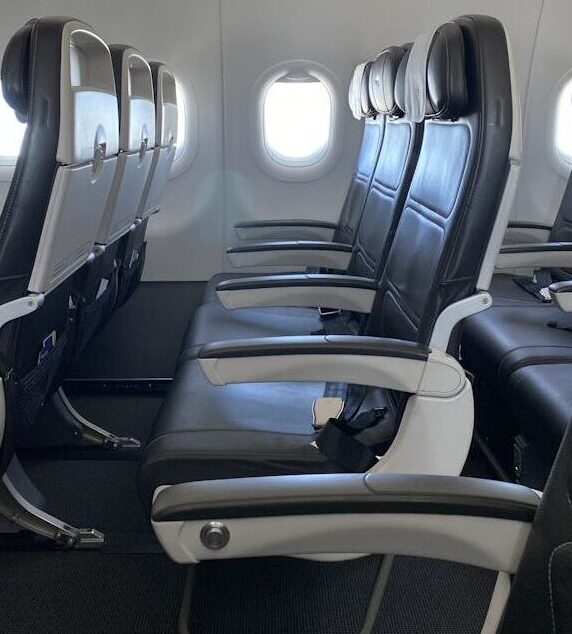
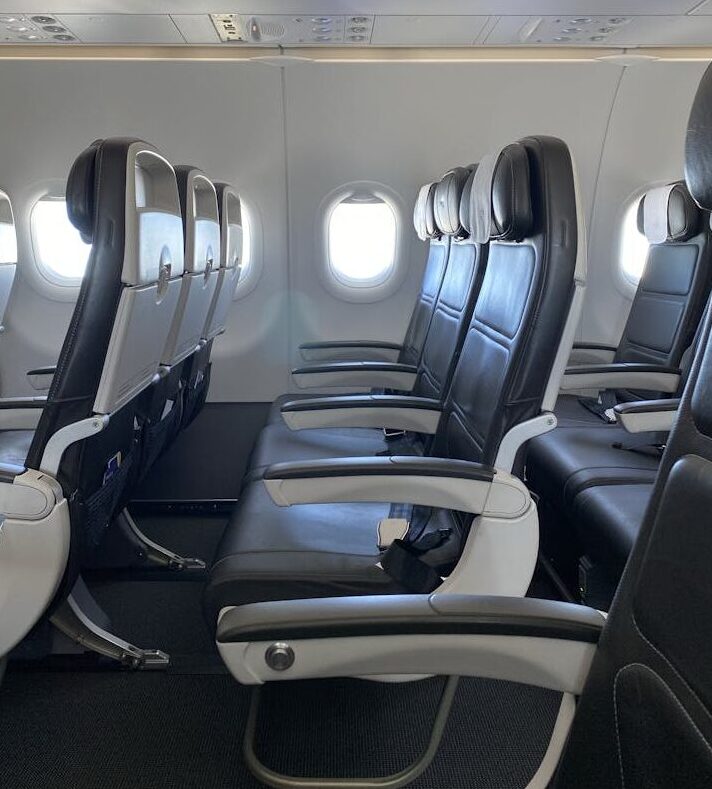
Seating
Sitting on an airplane for hours can be very challenging and often stops people from traveling to their dream destinations. My earnest opinion is that you should buy yourself a seat that provides you with more space than you get in standard economy. I do not want you starting your trip with extra stiffness/soreness, especially if it limits your mobility for the rest of your trip.
Some airlines have a limited number of seats in economy that offer extra legroom. In premium economy or business class, you will have dedicated overhead bin space, giving you even more legroom. You will be able to stretch your legs, bend forward when needed and not be trapped when the person in front of you reclines. In business, a lay flat seat is another level of benefit for those with orthopedic aches and pains. There is usually a much larger step up in price from premium economy to business than from economy to premium economy. Check out my 10 Seated Exercises to Do on an Airplane post to make those long flights a little more tolerable.
Bathrooms
Airplane lavatories are another compact part of flying. The biggest considerations here are making sure you can maneuver yourself in a small space and get up and down from the toilet seat. On long-haul flights, the toilet seat is regulated to be 18” high flying to/from the U.S. One upside to a small lavatory is that you will never be far from the wall or counter should you lose your balance.
Check out this post from WheelchairTravel.org for details about accessible airplane lavatories.
Trains
Major European train stations are massive travel hubs. There are many perks to ditching a plane once you are in Europe and continuing on by train the remainder of the trip, especially if you are not renting a car. When considering that you get to an airport two to three hours early, a train can actually save you time on your feet.
An incredibly useful resource for train travel is The Man in Seat Sixty-One. I have used this site for years and it has saved me from making numerous train mistakes. He provides station guides, information on train seating and bathroom layouts, troubleshooting, and traveling by train to almost anywhere in the world, particularly within Europe.
Mobility at the Train Station
Train stations can be large and crowded. Finding your train track can be challenging. It may be on the opposite end of the station. For example, transferring between high speed and local trains in the Munich Hauptbahnhof required me to walk 10 minutes with luggage. Transferring at Paris’ Gare Montparnasse station can even include you taking an escalator to another level of tracks.
Getting into the main part of the train station from the street should be straight forward and open up to a large space. Find a wall or post to stand next to and stop and look around to get your bearings. Stopping in the middle of a steady stream of people not only puts you at risk of getting bumped, but also makes it difficult for others to move around you, especially when they are in a hurry to catch a train. Learn more in this post about maneuvering European train stations.

Getting on/off the Train
Trains may involve a couple entry steps, especially if they are regional trains at smaller stations. Newer trains and stations have eliminated any changes in elevation between the train and the platform so that there is just a small gap you need to step over. You also need to consider getting your luggage on and off the train. At large stations, you will not be able to have someone without a ticket or who does not work at the station come on and store your luggage due to security measures and ticket checks at the start of the platform. It is common that train stations will have or contract with a company to handle your bags. You will need to organize this ahead of time, usually through the train company’s website.
Storing your Luggage
Once you are on the train, you will have space above you for small to medium bags. This overhead space is much smaller than on airplanes. Larger duffel and roller bags will need to be placed in the racks at the ends of the train cars or in between seat backs. As Americans, leaving your luggage out of sight can be nerve wracking, but it is very commonplace. Keep your valuables and medications in the bag that you place above you.
Seating
A notable perk of train travel is spacious seating. You will have ample legroom and seat width compared to an airplane’s economy seat. If you choose a first-class train seat, expect additional legroom and greater seat width. Long-haul trains usually have a 2-2 seat configuration in second class with table seating interspersed. In first class, it will likely be 1-2 configuration. Accessible seating should be marked when booking at seat selection online as well as how close your seat would be to luggage storage, the meal car and a bathroom.
Bathrooms
Again, these will be larger than airplane lavatories. While nothing special, they will give you room to turn around without bumping into a wall. Most European trains now have accessible bathrooms, especially long-haul, high speed trains. This should be specified when you are making your booking, usually visible when you can look car by car in the seat selection section.
Buses
In terms of mobility, there are not significant differences with charter buses and public buses so I am grouping them together here.
Mobility at Bus Stops/Stations
Generally, European city bus stops will have a pole with bus numbers and oftentimes a timetable. There may be a bench or small shelter to stand under but do not depend on it. You will likely be at bus stop if traveling on a local bus or they may stop in front of a train station. For longer bus trips, you will likely be going to a bus station. Most bus stations will not require you to go up/down a floor like some train stations. A city’s bus station and main train station can be far apart. Transportation between the two may or may not be readily available so it is good to check this before finalizing travel plans.
Getting on/off Buses
Long-haul, charter-type buses will require stairs. This is usually two or three steep stairs with one or two sturdy rails. City buses, especially in larger towns will be wheelchair accessible so the bus can be lowered and a platform will come out to raise you up or lower down depending. Often times, a driver will lower (kneel) the bus to decrease the space between the curb and the bus if they see someone with a cane or walker. However, this is up to the driver’s discretion and is not possible with all buses.
Storing your Luggage
If using a charter bus, your big luggage will go below (the driver may or may not assist) and you can keep a smaller item with you (usually a small purse and an overnight bag will both be allowed). The storage space above your seat, however is usually very small like on a train. Do not assume you will have space under the seat in front of you to stow anything.
I am a big supporter of public transportation while traveling, but luggage and city buses/metro are a tricky combination. Here are some factors to consider. Are you able to get all your luggage on/off the bus quickly while other people are waiting to board? If you find a seat, will you be able to keep your luggage in your lap or right next to you without blocking an aisle? If you cannot sit down, will you be able to hold onto a pole/overhead bar and hold onto your luggage safely?
Does any of this give you pause? If so, it’s likely worth using another mode of transportation to get to your destination with your luggage. A taxi or a shared shuttle are good alternatives. Some cities have dedicated trains to the airport, meaning they will have places to store your luggage. You will still need to consider how you will get to/from that station.

Seating
Legroom can vary widely on a bus but you will likely not have much legroom on a public or charter bus. However, some seats face sideways on a city bus. Thisi would prove more legroom if the bus is not crowded with people standing. Remember that there may also be an additional step up into the row of your seat.
Bathrooms
If you are on a charter bus, a bathroom will likely be available. Keep in mind it will likely be the size of an airplane bathroom. The trip to/from the bathroom will likely be bumpier than on a plane. Public buses within cities will not have bathrooms. Long-haul public buses may have a bathroom or will make stops every couple hours at a facility with toilets. When you are booking a public bus from one city to another online, it should indicate if the bus has a bathroom, air conditioning, etc.
Taxis
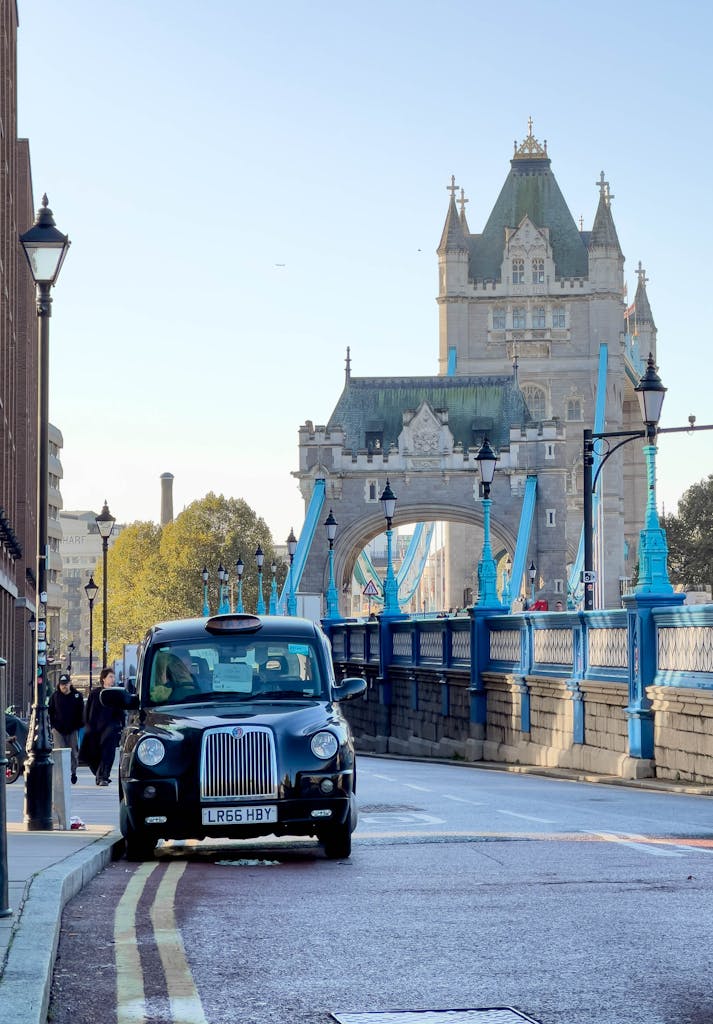
You will not have much choice when you hail a cab or have your hotel or a restaurant call you one. They will likely be on the small side, requiring you to sit low. Low sitting cars can be difficult for some people to get out of. In general, standard taxis will have room for your cane and possibly a fold-up walker. If you need an accessible taxi, it is best to arrange these ahead of time or call your hotel to ask about realistic wait times. A truly accessible taxi will allow a wheelchair user to stay in their chair for the ride. It is best to confirm when booking a taxi that it can accommodate any assistive device you are using.
Rental Cars
I will cover mobility considerations for rental cars in detail in a future post. In Europe, it is unlikely you will find large rental cars/SUVs and even finding a small SUV may be difficult. Consider the height of the car, size of the trunk and how you will get luggage in and out. Ask if the rental car company will be able to guarantee you the exact car you want if you have specific needs. If they cannot, are the other cars in that category comparable to what you require? It will be best if your booking confirmation includes that a specific car is required or that you have a backup plan (maybe a second, cancellable booking) if the first does not work for your specific needs.
Read Related Posts from Have Age Will Travel
Trekking Poles and TSA Airport Security
Mobility-Related Questions to Ask BEFORE you Book your Lodging
How is my Mobility for Travel?
All About Robotic (Autonomous) Airport Wheelchairs
Pin this Post to Refer to later or Share with your Friends!