Interpreting Activity Levels For Guided Tours and Excursions
Most tour companies and cruise ship excursions now display activity levels/requirements to meet in order to participate in their itineraries. If you have been on a guided tour or cruise, you have probably encountered people who were very capable of the planned activities and those who were challenged when trying to participate. How do we gauge if we are meeting expectations or are below the bar? That is what this post aims to do.
We will first look at some specific activity level examples from guided tour companies. Secondly, we will cover general tips to help you decide if specific itinerary is right for you. Lastly, we will discuss what you can do if your options seem limited. Here are some examples.
Examples of Activity Levels for Guided Tours
Road Scholar
Road Scholar creates trips for adults over 50. Here are how they define activity levels for their tour offerings:


From their descriptions, Easy Going requires you to climb stairs. There may be trips where that can be avoided but that would need to be a specific question for Road Scholar before you book. In their outdoor trips, their baseline requires you to walk on uneven terrain and that you are used to increasing your heart rate for exercise. Learn more about Road Scholar’s activity levels on their website.
Intrepid Travel
Intrepid Travel offers many different tours all over world. They do not specify ages for their trips but do offer family trips for children as young as five and do offer specific “young adult” trips. Here is how they rank their trips in terms of activity level.

As you can see, Intrepid’s physical rating descriptions are more vague. They do mention their itineraries are designed for people with an “average level of fitness”. That can be interpreted many ways. In the medical community, we would take this to mean that you can be out in your community without physical assistance. You are able to step up/down on curbs, walk through multiple stores, cross a street in the given pedestrian crossing time, etc. Do remember that European towns have been around much longer than American towns. Expect uneven surfaces, inclines/declines, unavoidable steps. For reference, Intrepid rates their “Cycling through Provence France” tour a 3/5. They offer one trip in Europe ranked a 1/5 which is titled “Italian Family Holiday” with children as young as five allowed. More on Intrepid Travel’s physical ratings here.
Rick Steves’ Europe
Rick Steves’ Europe tours cater those 12 and up. Their specific family tours do allow for children as young as 8 years old. These itineraries cover Europe. Here is how they describe physical demands and activity levels of their tours.

Each tour gives a simliar list. For bus tours, they also require you can sit for 2 hours at a time before a rest stop. They also indicate if AC in hotel rooms may not be guaranteed. They also rate each tour from Least Active to Most Active as seen below:
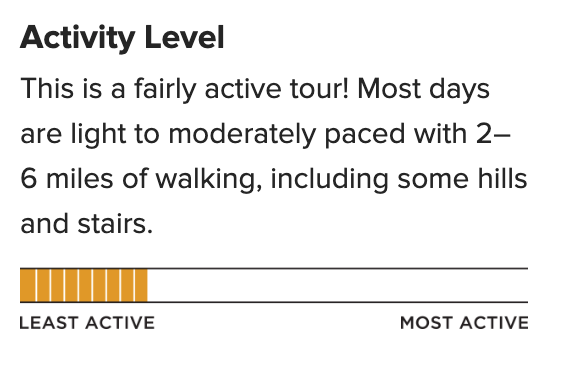
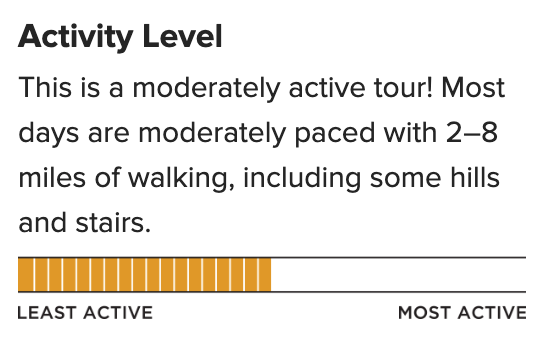


Immediately from Rick Steves’ Europe, you know that you need to be able to climb stairs. You also know that you are responsible for transporting your luggage to/from your hotel room. You are also expected to be able to walk at least two miles each day for each of their tours. Learn more about Rick Steves’ Europe tours on their website.
From these three company examples, you get a good idea of who their tours are geared towards. It also shows how tour companys’ activity levels vary greatly. Each of these companies do also list daily activity levels in their itineraries. Both Roads Scholar and Intrepid allow you to search tours by activity level while Rick Steves’ Europe does not.

Cruise Excursions
Cruises offer flexibility in terms of how much activity is required. For safety, you will find that all cruise lines require that a person is able to get off the ship independently or by the help of a caregiver (not a crew member) with or without an assistive device in case of an emergency. The larger the ship, the more excursion options there will be for different mobility levels. This also gives you the ability to do activities that are most important to you and then be able to rest on the days where you are not as interested in the activity. It would also allow you to do different activities than others you are traveling with and still meet at the start and end of the day. For more on overall accessibility on cruise ships, read our post Cruising with Mobility Considerations.
How to Ensure you have the Appropriate Activity Level for the Trip
Ask the Company
The best thing you can do is contact the tour company specifically. They want you to have a great time and they should be able to give you specific requirements about physical requirements. They also get feedback from tour members and will be able to share insights. Some tour itineraries may be flexible. Perhaps there are alternatives for you when an activity will be too strenuous for you. If it is primarily a bus tour, are you able to stay on the bus? Would there be a cafe that you could go to while the others are doing the activity? Other tours may have built in “free time”. This would allow you to save your energy for the group activity and then rest in your hotel or people watch in a cafe for a couple hours rather than continue to be on your feet.
I contacted each of these three companies. Both Road Scholar and Rick Steves’ Europe emphasized the importance of contacting the company with your mobility questions and concerns. They will be able to answer your specific physical requirement questions for each of their tours. They would also help you select a tour that would work best for you.
Be Honest with your Activity/Fitness Level
When looking at a tour listing or excursion, think about the past week. How mobile were you? How much of the time did you sit versus stand or walk? Did you take stairs? We may have an activity level we think we are at but it may not be reality. I often have patients tell me their goal is to get back to a certain activity. When I ask them further about the activity, often times, they stopped the activity long before they started having the pain for which they came to see me. Being able to walk for 3 miles 10 years ago may not seem like too long ago, but it is. Are you looking to improve your fitness level? Get our guide below:
On the flip side, what if you sign up for a tour that is below your regular activity level? This may leave you feeling underwhelmed. Especially if you are traveling with friends or family that do not get around as easily as you, make sure you still have ways to be active. If the tour gives you “free time” some days, you can go for a walk or do some activity you want to do that the others are unable to do. If you are a regular exerciser and do not feel like your tour will give you the exercise you want to maintain, ensure you are staying in a walkable/bikeable area, have access to a gym, or have good enough internet to stream an online workout you already do at home.
Consider also the other members of the tour. If you signed up for a tour that you know is too strenuous for you, you are affecting the quality of the trip for others. If the pace has to be slowed for you or the guide is constantly having to tend to you, the tour is unlikely what was promised to the other members. Alternatively, if you are trying to push the guide to go faster or to fit in more activity, that is also not fair to your fellow tour members.
Simulate a Day of the Tour
Are you unsure how your fitness stacks up? Take one of the tour days’ itinerary and try to simulate it at home. If we take the “Moderately Active” description from Rick Steves’ Tours, try to walk 4-5 miles during the day. Take a flight of stairs multiple times. Stand and walk a combination of 2-3 hours at a time. How do you feel? How do you feel the next day? Would you be able to replicate this for 7-14+ days?
What to do if the Trip is Not for You
Ask the Tour Company for Recommendations
If you discover the tour or excursion to not for you. You still have options. The tour/cruise company may have other tours/excursions that meet your needs. If you are set on a specific destination, see if they will recommend another tour company that may be a better fit for you. For cruise excursions, perhaps they can recommend a private guide that will be able to take you to what you want to see at your pace.

Consider Touring on your Own
Do you want the ultimate freedom in pacing your trip based on your activity level? Plan your own trip. Stay in only one or two towns and enjoy getting to know them well. You can have a car pick you up directly at the airport, book a hotel that will move your luggage and will guarantee a step-free room and elevator. Booking day or half day tours with transportation can allow you to sightsee however works best for you. You can plan rest days or plan only a plan a portion of your trip and then fill it based on how you are feeling as you go along. A travel agent would also be able to do this for you if all this planning is not for you.
Improve your Fitness
If your overall fitness level is the reason why a guided tour or excursion is too difficult, you may have options. Based on your medical history, you may be able to improve your fitness level and reward yourself with that trip you have been wanting to take. I have several posts on this blog that can help you with this. I have linked some of the posts below.
Improving your Mobility for Travel: Who to See
Do You Need Physical Therapy or Personal Training?
Travel Mobility Tests: How is my Mobility for Travel?
I hope this has been helpful in decoding guided tour and excursion activity levels! Have Age Will Travel’s goal is for you to be able to travel, no matter your mobility level. I hope this post helps you do that.
Want More of Have Age Will Travel?
Sign up for our newsletter. You will get additional content, learn of new posts first and get my travel insights. We do not sell your email address or send you spam. You may unsubscribe at anytime.
Pin this Post to Share or Save for Later!