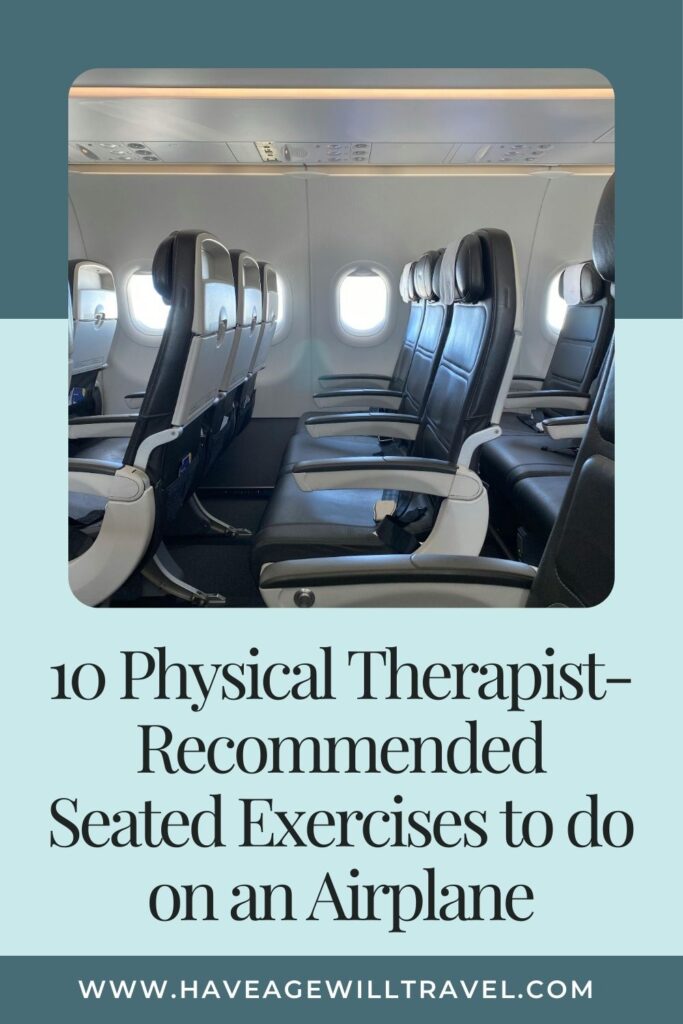
10 Seated Exercises to Do on an Airplane
Sitting for the duration of a flight is tough. Flying across the world and sitting for 10+ hours is even tougher. With the combination of less personal space on planes, “fasten seatbelt” signs being illuminated for longer durations and fuller flights, doing some exercises in your seat may be more beneficial than ever. Aside from assisting with your circulation (see my compression sock post for more on that topic), doing some seated exercises help keep your muscles mobile and joints lubricated. This can lead to feeling less sore and stiff once you get off the plane. If you would like tips about how to make sitting for long flights a little more tolerable, read our How to Improve your Sitting Tolerance for your Next Flight post. Now, let’s discuss simple exercises you can do on in your airplane seat.
Disclaimer: I am a physical therapist, but I am not your physical therapist. The exercises below are ideas only. If any of these exercises bother you, do not do them. Please consult your physician or physical therapist for specific exercises tailored to you and any musculoskeletal concerns you may have.
Overall Comments on Airplane Exercises
I am sharing with you some of my favorite seated airplane exercises that I do myself and give my patients. This is not an exhaustive list. Aim to do these every two hours and also try to get up every two hours you are not sleeping. While this sounds easy, I recognize that it is not. If you do some of these exercises even once through a long flight, I think you will see some benefit. Remember, a little bit of physical activity is better than none!
These airplane exercises can also be good options to do while your seatmate has left to use the bathroom. Do not worry about looking odd. If anyone else notices what you are doing, they will be thinking they should be doing some as well! These exercises can also apply for train and car trips pending space. The picture(s) for each exercise is above the description.
Muscle Activation Exercises
I want to point out that we are not focusing on actual muscle strengthening here, rather getting muscles contracting and relaxing and also to assist your circulatory system. The number of repetitions is not important, rather do enough to feel like your muscles have done something.


Seated Heel Raises and Toe Raises
The simplest of all airplane exercises involves movement at your ankles. I would bet we all do some version of this on a long flight without even realizing it. With your feet flat, slowly lift your heels up and down, raising up onto all 10 toes. If you want slightly more resistance, lean forward and/or rest your hands on your knees. Then, do several raising your toes up, shifting onto your heels. You may need to scoot your feet slightly forward to have more range of motion for the toe raises. Alternating back and forth between heel and toe raises works too as well as ankle circles or tracing the alphabet with your foot.

Long Arc Quads
Depending on how long your legs are and how much space you have in front of you, the amount of range of this exercise will vary. Sit with both feet flat on the floor, extend one knee, bringing the foot forward. Try to fully straighten the knee. If you do not have enough space, a smaller range of motion is OK. If you feel limitation due to a pull of your hamstrings, leaning back slightly in your chair should make it easier to fully extend the knee. Hold for 3-5 seconds and repeat. This works the quadriceps muscle on the top of your thigh.

Seated Marches
For this airplane exercise, sit upright and have your feet flat on the floor. Engage your core muscles and alternate marching one leg up and down. The main goal is to be able to lift your entire foot off the floor. If you can lift your knee high, great. If not, avoid forcing the height of the march as you will likely feel your trunk bobbing and swaying as compensation when it is too difficult.

Core Isometric
This exercise is the most inconspicuous of them all. Place your hands on the tops of your thighs, closer to your hips than your knees. Gently press directly down into your thighs until you feel your core muscles engage (mainly your transverse abdominis and rectus abdominis muscles). You do not want to press so hard that you feel strain in your back. Exhale as you push down and push for the duration of the exhale. Make sure your shoulders do not shrug up as your press down.

Shoulder Blade Squeezes
Next up, we have shoulder blade squeezes. This can be a helpful exercise because it activates the muscles on the backside of our shoulders and shoulder blades (scapulae), which are usually on stretch when we are slouched forward in a chair. Sit up tall and gently bring your shoulder blades together and down, like you are moving them towards the opposite back pockets of your pants. Hold 3 seconds and relax. Try to do the shoulder blade squeeze without puffing your chest out.
Bonus: Add a gentle push of your elbows into the back of your seat as you squeeze for some extra engagement. These should be slow, gentle presses, not punching back into the seat.
Stretches
I need to remind almost all of my patients about the importance of not overstretching. The goal is not to see how far you can go. Once you move into a range and feel a gentle stretch, that’s enough! Continuing to push into where it hurts can potentially cause a muscle injury and you will likely feel more stiff after stretching than before. Your muscles should feel relaxed after stretching. While in a stretch, if your muscles relax and you no longer feel the stretch, it is OK to then move further into the range to feel that stretch again. You do not benefit from being an overly aggressive stretcher!
For each of these stretches, try to hold at least 15 seconds, up to a minute. You can repeat these as often as you like during the flight. You can also incorporate breathing exercises or any mindfulness/meditation you enjoy doing as most of us are at least a little anxious on flights!

Knee to Chest Stretch
Depending on your hip flexibility, pulling your knee towards your chest with your hands will be a gentle gluteal stretch and low back stretch for some. This may be easier when your seat is semi-reclined. If you have the ability to lay flat, it will make this stretch easier to perform. If you have knee issues, make sure to hold under your thigh as pictured rather than over the top of the knee which compresses the joint.


Posterior Hip Stretch
If you have the space and flexibility, cross one ankle onto your opposite knee. Letting your leg rest in this position my be enough of a stretch for you. If you do not feel much, gently press town through your thigh as pictured until you feel a stretch. After that, you can also pull that knee up towards your opposite shoulder until you feel a stretch in your posterior hip muscles. Hold for a gentle stretch. These two stretches can easily be done laying down as well (just flip the images 90 degrees).

Seated Twist
We all tend to slump forward in chairs and airplane seats are no exception. For this stretch, start by sitting up tall, stacking your ears over your shoulders and your rib cage over your pelvis. Twist to one side, using either the arm rest or your outer thigh as gentle leverage. Hold and remember to breathe. If you can, let your head twist to look over the back shoulder. If you want to avoid looking at your seatmate, you can keep your head facing forward. You can play around with this stretch a bit, noticing the differences when your feet are flat on the floor and when you cross one leg over the other.
Note: If you have osteoporosis in your spine, be gentle with this exercise and make sure you sit upright. Slouching forward plus trunk rotation into the end range can increase your risk of a vertebral compression fracture. If you have any concerns, simply skip this stretch.


Seated Forward Fold
This stretch may be limited based on how much room you have in front of you. Sit with your feet flat on the ground. Slowly hinge forward, bending through your hips, not by rounding your spine. Place your hands and/or forearms on your thighs. If you feel a stretch here, stay and hold. If you do not, you can keep bending through your hips, trying to fold your trunk onto your thighs. This is also essentially the “brace” position for emergency landings, though I hope you never need to do that!

Upper Trap Stretch
For the last of the airplane exercises on the list, let’s stretch out the tops of our shoulders. The upper trap muscles are tight on the large majority of us. They run along the tops of your shoulders and shoulder blades and insert up at the base of your skull. Gently tilt your head in one direction, thinking about bringing your ear down towards your shoulder. Make sure the opposite shoulder does not raise up as you tilt. You should feel a stretch on the side you are tilting away from. Hold for a gentle stretch. If you have neck issues, this may not be a comfortable exercise for you, so discontinue. If this makes you a little lightheaded, be less aggressive or discontinue.
Have you Given these Airplane Exercises a Try?
Don’t forget to get your free PDF download of these exercises by signing up for our newsletter at the top of this page! Did you try these on your last flight? Let me know how they went and if you have any questions or feedback! haveagewilltravel@gmail.com.
Pin this Post to Pinterest to Share or Save for Later!