Rome: Transportation and your Mobility Level
Getting To/From/Around Rome and with Mobility Considerations
How you get into Rome and see Rome will depend on your mobility level and transportation preferences. Here we cover your options getting to/from the airport, Rome’s main train station and discuss your options of metro, bus, taxis and on foot while in the center of Rome. Links to helpful resources are provided at the bottom of this post.
Last updated April 2025

Getting to/from the Airport
The Leonardo da Vinci–Fiumicino (FCO) airport is about 20 miles from the center of Rome. You can take a taxi, bus or train in between. There is a transportation option for all mobility levels.
Taxi
There is a taxi stand/rank outside the airport that is well organized. It is a flat price of 55 Euros (as of 2025) from the airport to anywhere in Rome within the Aurelian Walls. It will take 40-50 minutes depending on time of day. Your hotel may offer to arrange this for you but may charge you extra. If you need an accessible taxi, you will need to schedule this ahead of time.
Bus
Several bus companies take you directly from the airport to the main train station (Termini). SIT also offers bus service between the airport and the Vatican. Depending on how close your lodging is to the Vatican or Termini station, you may still need to metro, taxi, walk or do a combination of the three to get to your lodging. Bus prices are about 7 euros one way and run every 30-60 minutes.
Train
The Leonardo Express travels directly between the airport and the Termini station in 32 minutes. Trains run every 15-30 minutes and the cost is 14 euros each way. Depending on how close your lodging is to the Termini or a metro stop, you may still need to take a taxi to your lodging.
An example of transportation options and mobility requirements: I stayed in the Monti neighborhood during my recent visit to Rome. The closest metro was a 10 minute walk from the hotel. I opted for taking a taxi to/from the airport and here’s why. If I would have used the bus or Leonardo Express to the Termini station, I would have also needed to take the Metro A line two stops and then walk 10 minutes with my luggage. Especially after a long flight and being jet lagged, I opted for most simple option.
Getting to/from Termini – Rome’s Main Train Station
Rome’s main train station is a major hub for Italy. If you are arriving into Rome by train, this will likely be where you arrive. Note: There are two other train stations in Rome; Rome Tiburtina and Rome Ostiense. They are both far from the center of Rome so it is best to get a train that arrives at Rome Termini if possible.
Metro lines A and B have a stop at Termini and many of the country’s fast trains stop here. Escalators or an elevator will take you between the train and metro floors. Termini is on the east side of the center of the city, far from the three most visited sites in Rome. As mentioned above, if you take the bus or the Leonardo Express train from the airport, you will end up at Termini. Then, you will likely either need to take a taxi or the metro to your lodging.

Metro
Rome has three metro lines. The third, C, is partially open with stops southeast of the center of Rome. The Colosseum stop is scheduled to open in 2025 (if not delayed). To ride, you can tap your credit card at the turnstyle. You can also buy single tickets (BIT), 24/48/72 hour passes or a card loaded with multiple trips (MultiBIT). I opted for buying MultiBIT tickets as I did not want to take my credit card out every time I wanted to ride the metro. A trip is 1.50 Euros. It is good for all public transportation (and any number of rides) within a 100 minute timeframe.
There are elevators or stair lifts for all metro stops except for Spagna, Barberini, Repubblica, Vittorio Emanuele and San Giovanni stops, which are all on line A. Elevators can break down frequently so it will be important to check the transportation website (Atac) prior to heading out for the day should you need use of accessible entrances. Note, this real time accessibility page is only available in Italian. You will need to use your web browser to translate it to English rather than switching to English on their webpage. There are no steps or height changes between the metro platforms and the metro car.
Note: Regarding your mobility level and transportation in Rome, expect to use other methods of transportation often when using the metro as your primary transportation. There are metro stops close to the Colosseum, the Spanish Steps and the Victor Emmanuel II Monument. Most other sites will require you to walk/wheel, take a bus or a taxi.
Buses
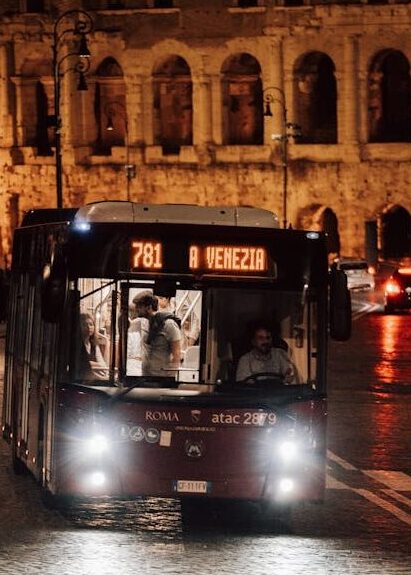
Buses run throughout the city and can get you much closer to places you want to see compared to the metro. This is an important consideration for Rome’s transportation options for your mobility level. They use the same tickets as the metro. You can also tap your credit card on the machine reader on the bus or use the same tickets as the metro. Schedules are listed on a pole at each stop. Currently, 98% of Rome’s buses offer boarding platforms for wheelchair and walker users. If not using the boarding platform, you will need to take the one step up onto the bus.
Taxis
Taxis are plentiful in Rome and cost less than in other major European cities. An important difference about Roman taxis is that you cannot flag one down wherever you see one. One either needs to be called for you or you need to go to a taxi stand/rank. This will help you avoid getting scammed but can mean you have to walk further to get to a taxi. If you need an accessible taxi, one will need to be called for you or scheduled in advance. Many taxis can fit a folded up walker or manual wheelchair in the trunk but not all.
Rental Cars
Rental cars are generally discouraged within the center of Rome. You would need to pay for parking as well as manage traffic, small roads and ZTLs (limited traffic zones). If you are using a rental car earlier in your trip, I recommend returning it before you get to Rome. Using these other modes of transportation, whether you have mobility considerations or not, will be a more pleasant experience.

Walking
You can get all over Rome on foot. You will rack up the miles if this is your main mode of transportation. See our Terrain post for more on walking in Rome. Being strategic about what neighborhood you stay in can help minimize how much time you’ll be on your feet. Remember to be realistic about transportation options in Rome and your mobility level. Using a map of Rome, mark the area/sites you are planning to visit. See if there is a clear area that would be ideal for you to stay in. If you are planning on taking public transportation often, perhaps you want to be close to a metro station. If you are only in Rome a short time and will be arriving and departing via train, staying closer to the Termini may be a good option. This way, you do not have to manage your luggage for long.
Links for Rome Transportation for your Mobility Level
Leonardo da Vinci–Fiumicino Airport (FCO) website
Leonardo da Vinci–Fiumicino (FCO) Airport’s website “To and From” page
The Leonardo Express Train to/from FCO
Rome’s Public Transportation website (Atac) – Note: I have found there to be less information on their site’s English version. Using your web browser to translate to English instead of using the website’s English option will provide you more information!
Public Transportation Accessibility page – This Atac page indicates which metro stops have elevators and escalators. It also covers bus accessibility and real time information on breakdowns or schedule changes.
Atac’s real-time “Status of Accessibility” webpage – This will show you which metro elevators or stair lifts are out of service.
A first hand report on using Rome’s public transportation with a manual wheelchair.
Tourist Office for the Archaeological and Cultural Heritage of Rome website page offering list of Taxi Rank locations including an interactive map.
Pin this Post for Later or Share with Friends!
Read more about Rome in our other Posts:
An Overview: Rome and Your Mobility