German Train Travel and Mobility
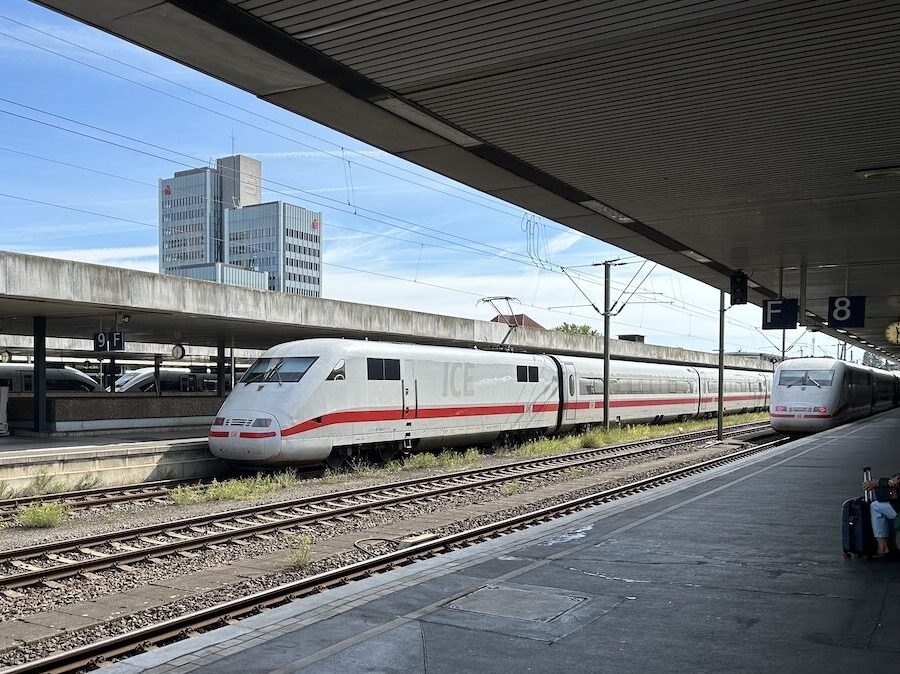
In this post, we will cover German train travel with a mobility focus. Germany’s national rail system, Deutsche Bahn, extensively covers Germany. It offers high speed rail, such as ICE and IC trains. It also offers regional trains, such as RE and RB trains. For more information on train travel in Germany as a whole, The Man in Seat 61 is an excellent resource that I use for my own travel planning. If you want to learn more about train travel and accessibility in Europe, see our post Mobility Guide for European Train Travel.
Mobility on German Trains
At the Station
Major German train stations have barrier-free entry. They feature accessible bathrooms and elevators to get you to each train track. The larger the station, the more step-free features they will likely have. You can look up each train station at www.bahnhof.de to discover if they offer assistance, elevators, etc.

Steps up/down from Train are Required
Currently, Deutsche Bahn trains require 2-3 steps to get on and off the train. If you are not comfortable going up and down stairs, you will want to contact Deutsche Bahn’s Mobility Service Center to see if lifts and/or ramps are available for you for your planned routes. See the next section for more detail. If this is not an option, you will need to find another mode of transportation.
Looking to the future, barrier-free trains are coming to the Deutsche Bahn fleet. The first trains, ICE-Ls (indicating low floor), will be starting at the end of 2025. You can read more on this on the Deutsche Bahn website.
Mobility Service Centers
Deutsche Bahn offers 300 Mobility Service Centers locations in their train stations. The center provides assistance getting on/off trains, i.e needing a lift or ramp. They can also help with booking tickets that require the least amount of distance when switching trains and ensuring you are given enough time to make a transfer.
The Mobility Service Center recommends that you contact them at least the evening prior to travel so that they can arrange assistance for you. Visit their website for more information. For a review from a wheelchair user after using several Deutsche Bahn trains, check out this blog post from Vicky’s Wheelchair Travels.

On the Train
Once on the train, there is ample space to walk down the aisle but also to grab the back of a seat for balance if needed. If you need an accessible seat, you can reserve them ahead of time. You can do this either with the Mobility Service Center or when buying your ticket online. First class seats will offer you more legroom and a wider seat. First class has one seat on one side of the car and two on the other compared to 2-2 in second class.
On IC and ICE trains, accessible bathrooms are available. Local trains will offer at least one accessible bathroom. It will likely not be as spacious as the ICE or IC trains.
What to Do with your Luggage
As you will likely need to take 2-3 steps up/down from the train, you will also need to do this with your luggage. This is a challenging part of train travel and reminds you of the importance to pack light! Make sure you will be able to lift your luggage on and off the train safely prior to travel. If you are unable to, you will need to have someone traveling with you who can help and has agreed to assist with your luggage. Transfers on/off the trains are rushed. There will be people lined up to get on and off and will not want to wait for those struggling with luggage.
There is another option for getting your luggage. The Deutsche Bahn partners with a shipping company, Hermes, that will take your luggage to your next destination. You can drop it off at one of their locations or they can come to your hotel/lodging and pick it up for you. Prices start at €19.99 per suitcase as of October 2025. The downside to this is that your luggage will arrive two working days later. This means you would need to bring a small bag with you on the train to cover those days but you would need to be staying in your next location long enough to receive your luggage.
Tips for Booking your Tickets
German train travel can be made easier for your mobility needs with good planning. The Deutsche Bahn app, DB Navigator, is user friendly and offers all the features you would need to book tickets, save tickets and check train status. It also allows you to look at train schedules and search for and book seats on trains. If you are considering a train pass, you will want to read the post on European Train Passes.
Train Schedules

I searched for future trains from the Frankfurt Airport to the main train station in Berlin (Hauptbahnhof). Two of multiple routes are seen in the screenshot on the left. Making train connections involves walking, especially if transferring from city transportation like the S9 as you see here.

I selected the first option, leaving at 18:41. You can now see the details of the trip. It gives you 12 minutes to transfer between train platforms. As scheduled, you get off the train in Hannover on platform 8 and get on the train to Berlin on platform 9. These platforms may be across from each other or you may have to cross train tracks, requiring stairs or elevator above or under the tracks. If we go to the www.bahnhof.de site, Hannover’s station map shows that the two platforms are separated by tracks.
Remember that planned platforms for arrival/departure of trains depends on timing of your train and other trains. Due to delays, trains may need to depart from other platforms, causing you to need to walk more than you had planned for when booking.
Seating


The two pictures above show seating options on the ICE train. Accessible seats can be selected as indicated in the first picture. The accessible restroom is indicated at the end of the train car. In the other screenshot, you can see where luggage racks are in relation to the bathrooms so that you can select the seat best for you.
I hope this has helped with your future train travel through Germany!
Share this German Train Travel and Mobility Post or Save it for Later!