
Best Travel Luggage – Focus on Ergonomics
If you type “Best Luggage” into a search engine or any iteration, you will have hundreds of pages of results, from companies selling you luggage to luggage reviews. This post is a little different. I am not recommending any specific item or brand. Instead, I am discussing features you should look for, meaning the ergonomics of your luggage. We will be discussing what to look for in travel backpacks and suitcases to provide the best fit for YOU and your travel needs.
I have also made a “cheat sheet” and a checklist for you for what to look for in a backpack and in a roller bag. Sign up to get our newsletter in the box at the top of this page and you will be emailed this information!
Travel Luggage Ergonomics
As a physical therapist, I find we often get confused about ergonomics versus body mechanics. Ergonomics is all about making the device, equipment, environment work to better fit YOU. When we talk about body mechanics, we talk about modifying our own movements and postures to better use or work with a device, equipment, environment. With luggage, we want it’s features and design to work for you. This means that one piece of luggage may work really well for your friend but may not work well for you. Backpacks will have many more ergonomic features/options than suitcases (roller bags) but we will discuss both below.
Backpack vs. Roller Bag
There are pros and cons to luggage you can carry on your person and luggage you can roll. We will use the terms backpack and roller bag to cover these two types. When discussing backpacks, I am referring to ones that will be a main piece of luggage for you, weighing more than 10 pounds. When I talk about a roller bag, I highly recommend a 4-wheeled one – more about this later. I have a separate post on lifting and carrying luggage: Lifting and Carrying Mechanics for Travel.
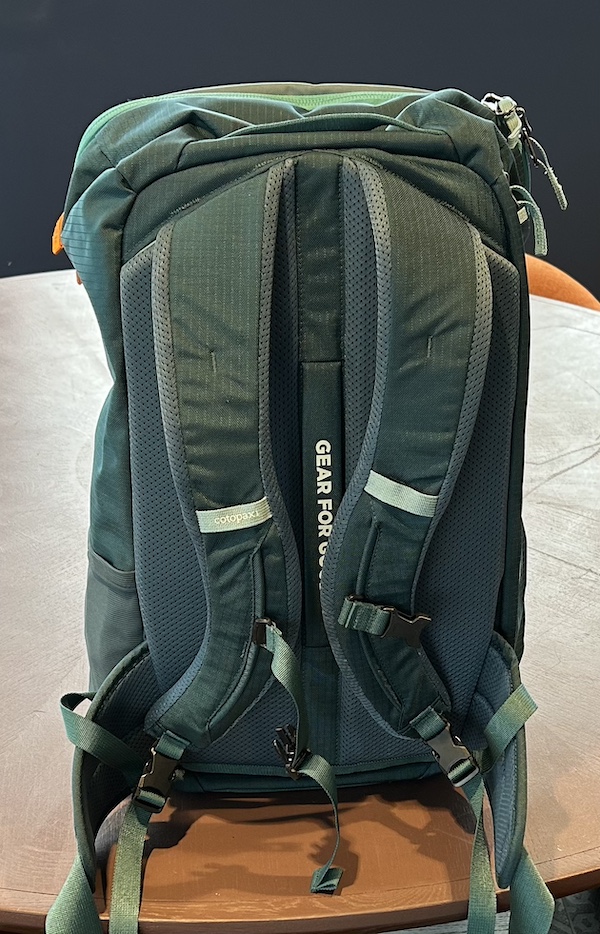
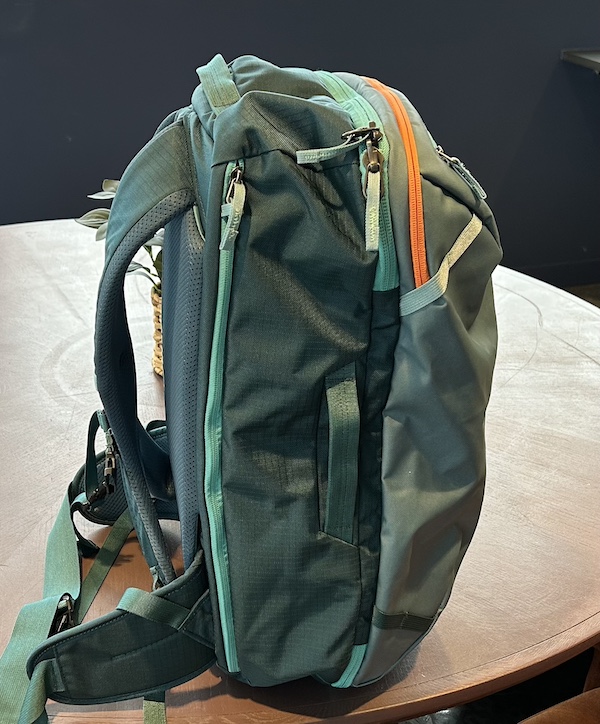
Backpack
At minimum, your backpack has two shoulder straps and a top grab handle. It may also have a hip belt, chest belt and a side grab handle. These three features are in the backpack pictured above. If you plan for a backpack to be your main piece of luggage, it is important that your backpack has a hip belt. The purpose of the hip belt is for the weight of the pack to rest on your hips and not on your shoulders. This helps minimize load through your spine.
A chest belt helps keep the pack close to your trunk, rather than there being a gap between the bag and your back. For some people, a chest belt will be too uncomfortable but some brands feature an adjustable strap which can make it easier to wear. The other main consideration is you want the backpack to contour to your spine. If you feel the backpack is pushing your head forward or it is uncomfortable to stand upright with it, this is not the bag for you. If you are looking at a backpack that comes in different sizes, checkout this guide from REI about measuring your torso length. You will see this most often in hiking backpack styles which can make good travel backpacks based on what you need.
Example:
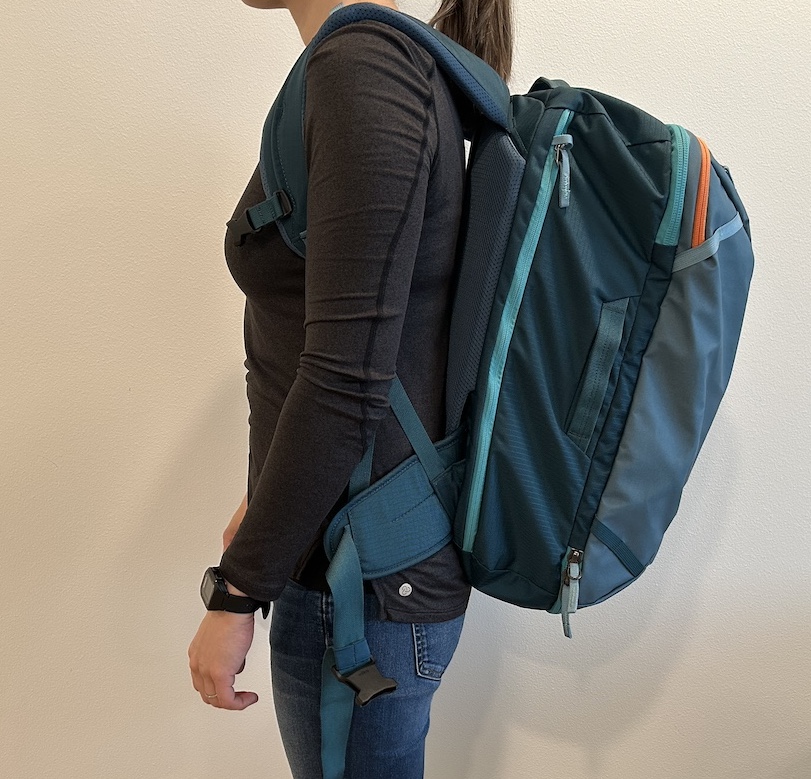
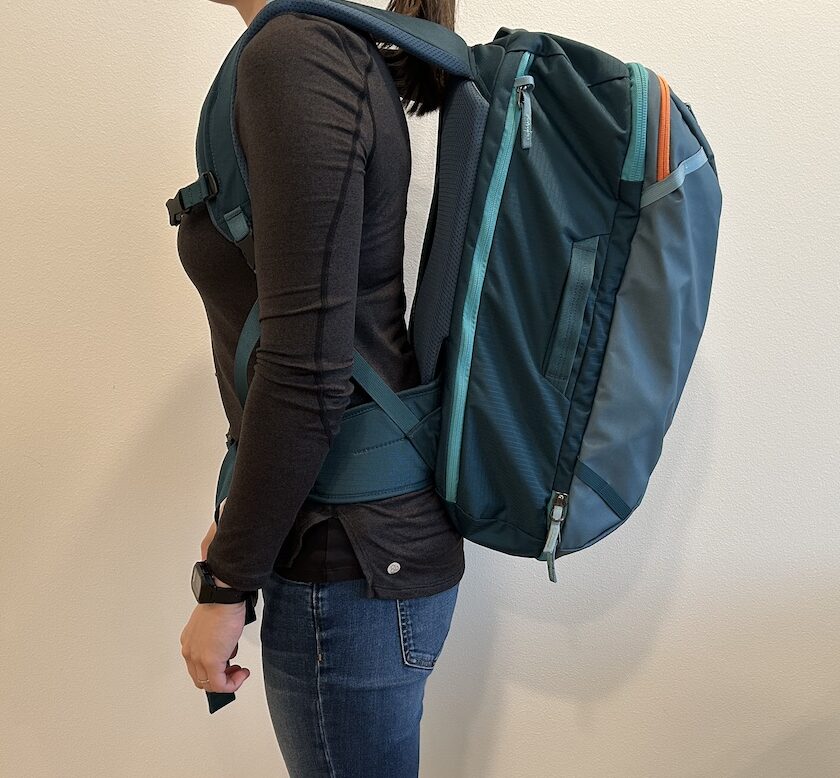

Let’s look at an example above of the backpack I use when I travel. It is the Cotopaxi Allpa 35L. The main reasons why I chose this bag were that it has both hip and chest belts and that it fits well against my back. The first picture is how the backpack sits without the hip or chest belt buckled. It shows that the weight of the backpack is resting fully through my shoulders and spine. When I buckle the hip belt in second picture, weight rests on my hips and takes pressure off of my shoulders. You can see however, that it adds a bit of space at the backs of the shoulders. We do not want to see a lot of daylight between you and the bag as it can pull on your back. Do you also notice how I lean forward to counteract that pull that I am feeling? This was an unconscious correction my body made. This is remedied with the addition of the chest belt in the last picture. There is still space at the shoulders, however, the chest belt secures the bag closer to my trunk than the first two pictures.
Roller Bag
I highly recommend a 4-wheeled suitcase vs. 2-wheeled. It is much easier to move and the rotating features decrease a lot of strain on your body. When using these, it is important to have it wheeling next to you rather than behind you. Test it out and make sure that it rolls smoothly over concrete, asphalt, and any other surface you plan on traversing. If you have trouble with your balance and your roller bag does not move effortlessly, this is a major fall risk! I will note that 4-wheeled bags are more difficult to maneuver over cobblestones vs. 2-wheeled. Considering your trip (airports, train stations and cobblestones), your time on cobblestones will likely be minimal to none compared to other surfaces better suited for the 4-wheeled but it still is something to consider!
You will want a roller bag that is lightweight but also durable. Another factor to consider is the handle of the roller bag. It should be adjustable and allow you to have your elbow bent around 20-40 degrees when using. You should not feel strain on your wrist or forearm muscles as you are pushing it along. Your wrist should be in a neutral position. Also with enough use, these handles will loosen with time. The more wobbly the handle becomes, the more force you lose to push the bag, making you work harder. If the handles have screws that are accessible for you to tighten, that is another bonus!
Example:
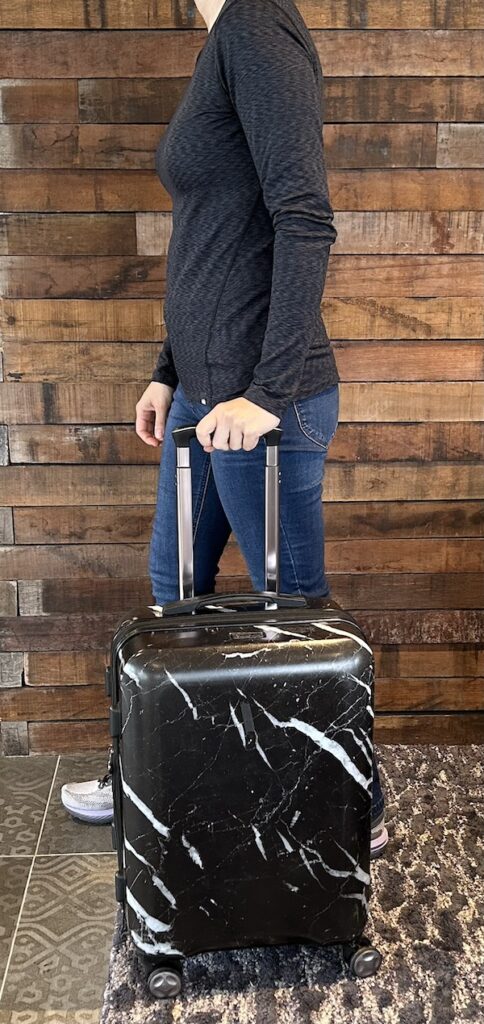

The pictures above indicate that I need a different roller bag! For reference, this is a carryon-sized roller bag. In the first picture, the handle is too low. See how I have to bend my wrist? This will put strain here and it also takes more effort to move the suitcase. In the second picture, my wrist is in a much better position and it is easier to roll than the lower setting. However, look at my shoulder. This puts unnecessary strain at the front of my shoulder. Ideally, the handle of this roller bag would have a setting in between these two for me specifically.
Warning against duffle bags : Even with a crossbody shoulder strap, a duffle bag is not ideal. It leads to large weight displacement and prevents you from walking normally. If you will be checking your duffle bag at the airport and then moving it very minimally during your trip (mostly in/out of car trunks), that is one thing. If you plan to walk through airports and train stations and down lovely small European streets, please do not use a duffel bag.
Considerations for Musculoskeletal and Neurological Conditions
Balance
Wearing weight (i.e a backpack) will actually improve your stability. Increasing your mass, especially with most of the weight of the backpack around your hips, will lower your center of mass, thus improving your balance. A roller bag can be a bad combination for some people with balance issues. If the roller bag does not move exactly as you expect it to, you can easily lose your balance.
A Note about Escalators and Luggage: I was behind a couple at the airport recently who was discussing if they should take the elevator or the escalator down to the next floor. One looked to have some balance issues. Each of them had a roller bag with another bag sitting on top. They decided to take the escalator. I was a couple escalator steps up above them with a a bad feeling of how this was going to go. Once they were near the bottom and were gathering their luggage, a bag tipped, the one with balance issues tripped, and they both ended up on the floor. It was luckily a slow motion fall and they both seemed OK. I was impressed by how many airport employees appeared almost instantly to assist them. Please do not start or end your trip this way. Escalators are tricky. Use the elevator if you have any hesitation.
Low Back Pain
A backpack can often increase someone’s low back pain. This is especially true if the weight is resting on their shoulders instead of their hips. If weight bearing increases your low back discomfort, adding more weight will likely increase these symptoms. In most cases, a roller bag will be a better bet for you. Roll your roller bag next to you, not behind you and switch sides occasionally if able. Rolling a roller bag causes a rotational force through your spine so being able to switch sides to even out the rotation will be beneficial.
Neck Pain
The main focus point if you have neck pain is to ensure your backpack does not push your head forward. The backpack should have adjustable straps for length and width so that you can “keep your ears between your shoulders” as we say. If you have excessive thoracic kyphosis (forward slouch), using a backpack can help support posture. If the majority of the bag’s weight is below the apex of your forward curve, you should feel that the backpack is assisting you in standing a bit more upright. Rolling a roller bag will likely not aggravate your neck pain. Lifting would be a more likely culprit.
Shoulder Pain
If using a backpack and the load is resting through your hips, this should not aggravate any shoulder issues. If you have a backpack that you know adds some load up top, you will want to do a test walk with a packed backpack to assess. Also, how does it it feel putting the backpack on and taking it off multiple times? (Hint: put the backpack on through your symptomatic shoulder first and take it off through the non-symptomatic shoulder first). Also try putting the backpack on and taking it off when wearing a sweater or jacket to make sure it still is easy to do pending on what time of year you are traveling.
Rolling the roller bag with your symptom-free arm eliminates most issues. You will want to make sure you feel comfortable maneuvering the roller bag if you are using your non-dominant arm. Also, most roller bags need to be lifted with both hands. Can you lift your roller without irritating your shoulder?
Knee Pain
I often remind my patients that one pound of body weight equals about 4 pounds of force through your knees. WOW. Here is a study using 3-D gait(walking) analysis if you would like to learn more. If you have knee issues, especially knee osteoarthritis that causes you pain, and plan to wear a 20lb backpack for your trip, we are talking 80lbs of extra load through your knees. This may be a situation where you will want to have the lightest backpack/shoulder bag and focus on using a roller bag. If you are trying to pack light and need incentive, think about this the opposite way. If you remove 2 pounds of weight from your backpack, you are saving 8 pounds of force through your knees!
Some Final Tips
As I always recommend, if you have specific questions about what luggage is best for you, ask your physical therapist! Your physical therapist will be able to speak with you specifically about your travel goals, luggage needs and match that with how you are moving and any musculoskeletal concerns you have.
When possible, go to a store and test out the backpack or suitcase first. Assess the ergonomics that you have learned here. If the backpack does not fit your trunk or the suitcase does not move easily, put it back and move on. If you order online, make sure there is a good return policy and that it is easy for you to return. Online reviews can be helpful, especially sites where reviewers share their height and weight so you can compare. Video reviews of bags can also be helpful. Spending time finding a good piece of ergonomic luggage can make your trip easier and more comfortable.
Don’t forget to get your free cheat sheet and checklist for luggage ergonomics by signing up for our newsletter!
Links to other Posts
Anatomy of a Tennis Shoe – An Overview
Best Shoes for Travel – Thoughts from a Physical Therapist
Physical Therapist-Recommended Travel Gear
Pin this Post about Ergonomic Travel Luggage on Pinterest!