
Physical Requirements for Visiting London’s Top Sites
Visiting the sites in London would keep one busy for weeks! Learn about physical requirements for visiting London’s top sites, how to get there, and what to expect. In this post, I cover three of the most visited sites: the British Museum, the Tate Modern, and the Tower of London. For these London sites, learn the physical requirements needed for each. As a bonus, I am detailing one additional site that is fully accessible but you will have to subscribe to my newsletter to learn what it is!
The British Museum
The British Museum is one of the greatest collections of antiquity anywhere. The museum has been welcoming visitors since 1759. While there is controversy surrounding which artifacts the British Museum should have and what should be returned to countries of origin, there are few places where you can see the degree and range of human existence on earth. The museum is open daily.
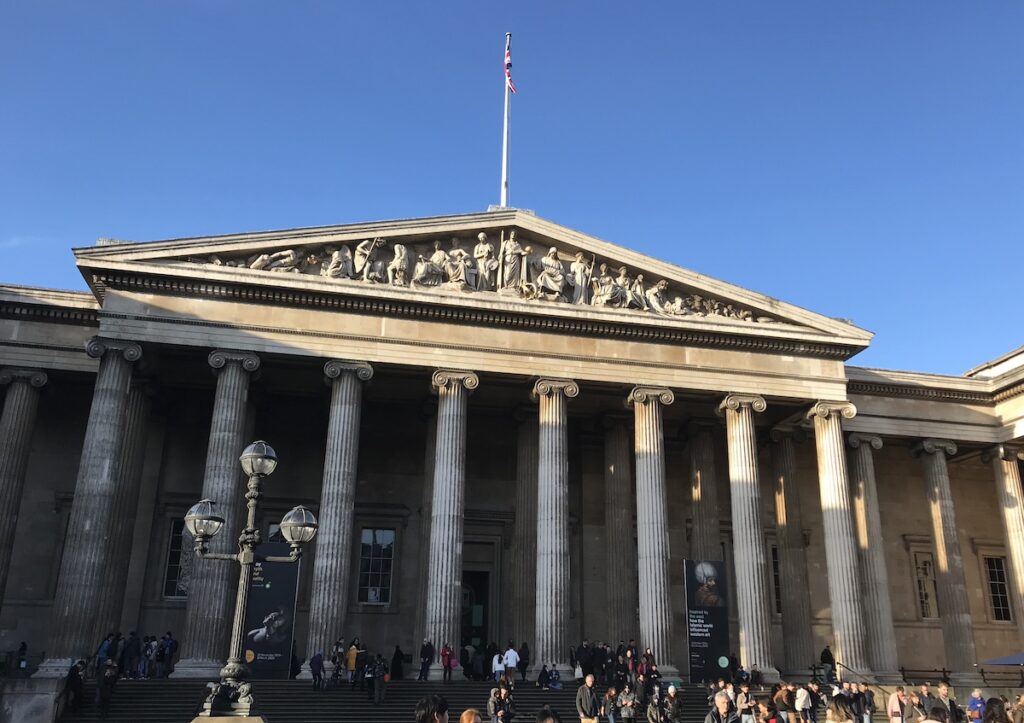
Entrance/Exit
Entry to the museum is free. It is highly recommended, however, to book a time slot in advance. This will not only save you precious time but also limit how much standing you will need to do. You do not want to be tired before you even enter the museum! As with all sites, you will still need to stand in the security line.
The main entrance is on Great Russell Street. There are 12 steps to maneuver with use of a handrail. You can also enter at the north entrance on Montague Place and must enter here if you do not already have a timed entry ticket. The north entrance also has 12 steps but does have an elevator available.

Inside the Site
The majority of the museum is accessible via elevators. The rooms that do require ambulating a step or stairs include: 16, 20a, 21, and 69. Accessible toilets are located on level 0 and near the north stairs and elevators at levels 3 and 4.
While in the museum, you will be on smooth stone flooring. There are occasional stools and benches in the rooms and foldable stools are available inside the main entrance. There is also seating in the eateries and in the main gallery. You can pre-book a wheelchair to use inside the museum. They recommend booking two days in advance. Email: tickets@britishmuseum.org, Phone: +44 (0)20 7323 8181.
Getting to the Site
The Underground
The four closest tube stations are about a 5-10 minute walk from the museum. Tottenham Court Road (Elizabeth, Central and Northern lines), Holborn (Central line), Russel Square (Piccadilly line), and Goodge Street (Northern line)
Bus
The New Oxford Street – Museum stop is the closest to the main entrance. Buses 1, 8, 19, 25, 38, 55, 98, 242 stop here.
The Tottenham Court Road (northbound) and Gower Street (southbound) stops are near the corresponding metro stops. Buses 14, 24, 29, 73, 134, 390 stop here.
Southampton Row is one block closer to the museum than the Holborn tube stop. Routes 59, 68, X68, 91, 168, 188 stop here.
Taxi
Taxis can drop you off and pick you up on Holland Street, directly in front of the museum.
Useful Links
Accessibility Page of the British Museum
AccessAble’s British Museum Page

Tate Modern
The Tate Modern is London’s Modern Art museum. It is located just south of the Millennium Bridge. It is free to enter (fee for exhibits). Like the British Museum, it is recommended that you reserve a timed-entry in advance, especially for exhibits. The museum is open daily.
Entrance/Exit
The main entrance is at the Blavatnik Building off of Park Street. This southern entrance is a long, gradual incline. There is a steeper, declined, ramped-entry at Turbine Hall. This is on the west side of the museum. Both entrances have automatic sliding doors.
Inside the Site
Of London’s sites, the Tate Modern offers low physical requirements. The flooring is level and smooth. You can reserve a manual wheelchair or scooter in advance free of charge. You will need to contact the museum at least a day ahead to reserve (Call +44 (0)20 7887 8888 – option 1, daily 10.00–17.00, Email ticketing@tate.org.uk)
Fully-accessible toilets are located at each level of the museum. Elevators are located next to the stairs at each level. Seating and benches are located around the museum. Folding chairs are available at levels 2, 3, and 4. There is a cafe, an espresso bar, and a restaurant if you want to rest your legs for a prolonged period of time.

Getting to the Site
The Underground
Four tube lines stop nearby the museum. The Jubilee line stops at Southwark, about 0.4 miles away. District and Circle Lines have stops at Blackfriars, about a half mile from the museum. The furthest stop is at St. Paul’s. This Central line stop is about 0.7 miles away.
Bus
About a quarter of a mile east of the museum is Blackfriars Bridge Road bus stop for buses 40, 63 and 100.
Both the Southwark Street and Southwark Bridge Road stop for routes 318 and 344. These stops are next to each other and are about 0.3 miles from the main (Blavatnik) entrance.
Taxi
A taxi can drop off/pick up in front of the museum on Holland Street. The Turbine Hall entrance will be the closest entrance.
Useful Links

Tower of London
This London castle is a Unesco World Heritage site and was built by William the Conquerer in the 1070s. It was built as a fortress. Today, it is most known for housing the Crown Jewels. Tickets are £35.80 for adults and as with the other sites, should be purchased in advance. The Tower of London is open daily. This site has the highest physical requirements out of London’s sites we cover in this post.
Entrance/Exit
The entrance is on the west side of the complex. The gates to enter are at the southwest corner, through the Middle Tower. You will be walking over large stone pavers on the sidewalks. The road within the tower walls is made of cobblestones.
Inside the Site
There are many different buildings and areas of the Tower of London. Accessible bathrooms are located at the Brick Tower behind the Jewel House and at Cradle Tower. I have listed the different areas below in order of least physically demanding to the most.
The Jewel House
The Jewel House holds the Crown Jewels. It is the only step-free part of the Tower of London. It has a level entry and smooth flooring. There is a lift available to access all of the exhibit.
The Mint
The are no steps to climb to visit the Tower’s Mint – Coins and Kings. However, the floorboards are uneven in places.
The Chapel of St Peter and Vincula
These places require stepping down four stair steps and up one stair step. There are some spots with uneven flooring.

The White Tower
This houses part of the Royal Armories collection over four floors. As you can see in the picture above, you must climb about 3 flights of wooden stairs to reach the entrance. Handrails are located on both sides. Once you reach the top of the wooden stairs, there are 5 stone steps to get inside. Access between floors is via spiral steps and staircases with varying handrails. If wanting to visit the White Tower, you should be comfortable with ambulating stairs and do not get dizzy when going up spiral staircases.
Note: The basement level of the White Tower includes some of the collection and the gift shop. It has an elevator from the ground level, opposite the entrance to the Crown Jewels.
The Bloody Tower
This tower has 55 stair steps to maneuver. This includes some spiral stairways. Accessing the Medieval Palace requires climbing 24 stair steps and staircases once inside.
The Battlements
Visiting the Battlements involves walking around the inner wall of the grounds. The 162 steps you will cover includes some spiral staircases and occasional railings. Lastly, to visit the Beauchamp Tower, one needs to climb stairs with a handrail to enter. The upper and lower levels are connected via a spiral staircase.
Getting to the Site
The Underground
The Tower Hill tube stop is the closest stop the the Tower of London. Lines Circle and District stop here. There is elevator access at this stop. It is 0.1 miles from the entrance.
Bus
Bus routes 15, 42, 78, 100 and RV1 all stop within a half mile of the Tower of London entrance. Route 15 includes the Tower stop which is 0.1 miles from the entrance.
Taxi
Taxis can drop-off and pick-up in front of Tower of London entrance on Lower Thames Street.
Useful Links
Tower of London Accessibility page
Tower of London’s Accessibility Guide (pdf) from 2018
Links to other London Posts
Mobility Requirements for Visiting London: An Overview
Physical Requirements for London’s Terrain
London Transportation and your Mobility
Pin this Post to Share or to Save for Later!


